





Situated 47 kilometers north east of West Wyalong in central New South Wales
(NSW), Lake Cowal is the state’s largest natural inland lake. It is
part of the Wilbertroy-Cowal Wetlands within a large flood plain, the Jemalong
Plain. Fed by its major tributary Bland Creek and by occasional floods from
the Lachlan River, the lake is ephemeral but is
substantially full for seven out of ten years. As floods recede Lake Cowal
drains back into the Lachlan communicating with the Murray Darling Basin.
An Area of Ecological Significance
Lake Cowal is included in the Australian Register of the National Estate
and in its Directory of Important Wetlands. The National Trust of Australia
(NSW) has listed Lake Cowal as a 'Landscape Conservation Area'. The Australian
Heritage Commission has suggested the NSW government consider the Lake Cowal
region for listing under the Ramsar
Convention as a Wetland of International Importance.
Under the Ramsar Convention on Wetlands contracting parties (of which Australia
is one) are obliged to promote conservation, repair and wise use of all wetlands.
Australia has already lost 89% of its wetlands over the last century.
The New South Wales National Parks and Wildlife Services (NSW NPWS) states,
“Lake Cowal is listed on the National Estate because of the diversity
and number of species that inhabit the lake. For example, Lake Cowal has at
least three recorded accounts of more than 1% the Australian population of
some wader species. As such, Lake Cowal also meets the Ramsar Wetlands of
Importance listing criteria. The NPWS is of the opinion that Lake Cowal provides
significant wetland habitats and drought refuge both in area, diversity of
habitat types and duration of availability of resources.”
Lake Cowal is home to many endangered flora and fauna species including the
Austral Pillwort (Pilularia novae-hollandiae) Winged Peppercress (Lepidium
monoplocoides) Australasian Bittern (Botaurus poiciloptilus) Black-necked
Stork (Ephippiorhynchus asiaticus) Blue-billed Duck (Oxyura australis) Painted
Snipe (Rostratula benghalensis)
Freckled Duck (Stictonetta naevosa) Yellow-bellied Sheathtail-bat (Saccolaimus
flaviventris) Little Pied Bat (Chalinolobus picatus).
Lake Cowal Mine :An accident
waiting to happen?
The proposed ‘Mining Lease Application’ encompasses approximately
2,650
hectares. One hundred and twenty-eight
million tonnes of low to medium grade ore would be excavated from an open
cut pit 1 kilometer wide and 325 meters deep on the lake shore and partly
within the high water level of Lake Cowal to produce an
estimated 2.7 million ounces of gold.
In February, 1999, following the findings of a second Commission of Inquiry,
the New South Wales Minister for Urban Affairs and Planning, the Hon Craig
Knowles, signed a Consent to the development
application made by North Gold (WA) Ltd for an
open-cut cyanide leach gold mine (a deadly type of mining using a process
that has been made illegal in many countries around the world).
The only barrier between the lake and the open pit would be an earth wall
or bund. Tailings would be stored in dams 3.5 kilometers from the offical
lake edge (local people report that as recently as 1991 the lake has swelled
to some 50kms across). Water would be supplied from a bore in the Bland Creek
Paleochannel borefiled, 20 km east of the mine site and would pump up to 16
megalitres per day in an area that has high water restrictions for local residents
because of drought.
The tailings dams will be lined with clay not even using black plastic lining
and Heavy Metals such as zinc cadmium and lead could enter soil and waterways.
"Arsenic levels are high in this ore body."
Dr Barry Noller, Deputy Director of the National Research Centre for Environmental
Toxicology, in “Cowal Gold Project: Comments on the Environmental Impact
Statement” writes, “longer term generation of seepage under alkaline
pH and more alkaline conditions may give solubilization of arsenic. Note that
arsenic is soluble under alkaline conditions and that the predominant form
is arsenite. Arsenite is extremely toxic to biota and is a carcinogen. Evidence
the effect of population drinking groundwater in Bangladesh, through contraction
of skin cancer.”
How its done
Most gold mining uses one of the worlds most destructive processes in modern
mining.
Almost all mines use a cyanide leaching process to extract the gold from the
ore. In this process the finely milled ore is mixed with a sodium cyanide
solution that dissolves the gold. The reaction between the gold and the cyanide
ions is described by Elsner's equation:
4Au + 8CN- + O2 + 2H2O = 4Au(CN)2- + 4OH-
Activated carbon is then used to recover the gold from this solution. The
leaching takes place in large tanks holding many thousands of cubic metres
of solution and generally takes several days.
Cyanide is DEADLY
Popular concern over this technique has focused on the lethal impact of cyanide. A teaspoonful of two-percent solution of cyanide can kill a human adult. Cyanide blocks the absorption of oxygen by cells, causing the victim to effectively “suffocate.” Human exposure to high levels of cyanide for a short period harms the central nervous system, respiratory system, and cardiovascular system. Short-term exposure to high levels of cyanide (110 parts per million) can cause coma and/or death within 30 minutes to 1 hour. Cyanide impacts fish at far lower concentrations. Concentrations as low as five micrograms per liter have been found to inhibit fish reproduction, and adverse impacts have been reported at levels of ten micrograms per liter. This toxicity increases with any reduction in dissolved oxygen below 100%, and increases three-fold with a 12 degree celsius decrease in temperature.
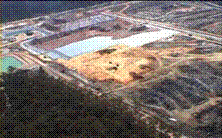
A cyanide tailings dam
what the mining companies say . . .
Mining and regulatory documents often state that cyanide in water rapidly
breaks down in the presence of sunlight and oxygen, into largely harmless
substances such as carbon dioxide and nitrate. They also insist there have
been no reported cases of human death from cyanide spills. Also scientific
studies show that cyanide swallowed by fish will not “bio-accumulate”
which means it does not pose a risk to anyone who eats the fish.
. . . and what mining companies don’t
tell you
Although cyanide solution eventually breaks down in the presence of sunlight
and air at pH neutral conditions, it will not do so when it seeps underground,
under cloudy or rainy conditions such as are seen in tropical countries, or
during winter in cold countries when lakes or streams may have snow and ice
cover and temperatures are reduced. If the cyanide solution is slightly acidic,
it can turn into cyanide gas, which is extremely toxic.
Furthermore, if the solution is alkaline the cyanide does not break down.
Furthermore, even in perfect conditions, not all of the cyanide used in mineral
processing breaks down quickly into largely harmless substances. Many of the
breakdown compounds, are still toxic to aquatic organisms, and may persist
in the environment for significant periods of time. Some of these toxic breakdown
forms include the free cyanides, metal-cyanide complexes, organic-cyanide
compounds, cyanogen chloride, cyanates, thiocyanates, chloramines, and ammonia.
Of these, cyanate is the main form of cyanide resulting from most cyanide
decomposition processes employed at mineral extraction sites. Cyanate may
persist in water for significant, but undefined periods of time. Ammonia,
another breakdown product, is considered to be about as toxic to fish as cyanide.
Some data indicate that the combined effect of ammonia and cyanide is greater
than would be assumed on the basis of their individual toxicities. Thiocyanates
cause “sudden death syndrome” in trout, partly as a response to
stress, and because, unlike free cyanides, thiocyanate is accumulated. Other
breakdown chemicals like cyanogen chloride may be more toxic to fish than
free cyanides.
Other Links
To find out how you can help contact
Nimbin Environment Centre on (02)66891441
or Email nimbineco@wildmail.com